

5 Recommended AI Text Summarization Tools: How to Choose a Next-Generation Tool That Does More Than Summarize
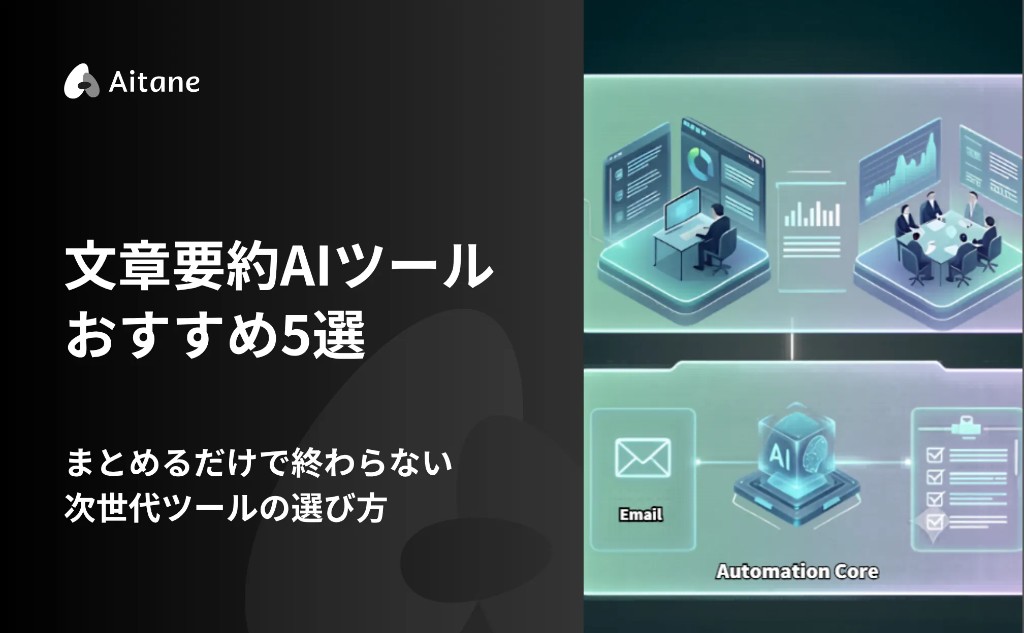
Do you ever feel that summarizing meeting minutes and sales notes eats up so much time that you cannot get around to your actual sales activities or customer follow-ups? This kind of workload pressure is a challenge shared by many business professionals. This article explains the basics of AI text summarization tools and the benefits of adopting one, and introduces five recommended tools for business use. It brings together tips for choosing a system that fits your company and driving operational efficiency. We also cover how to choose a tool that goes beyond summarizing text to automate downstream work such as CRM data entry and email sending. Use it as a reference for reducing the burden on your frontline teams and selecting the best AI text summarization tool for you.
What Is an AI Text Summarization Tool?
An AI text summarization tool uses AI to analyze long text and condense it into its key points. Feed it the documents you deal with every day, such as meeting minutes, reports, emails, and news articles, and it automatically generates a summary containing only the important points. Traditionally, people wrote notes and summaries as they read. By handing this work to AI, people can spend their time on what they should really be focused on: conversations with customers and decision-making. That said, tools fall into two categories: those that only summarize text, and those that can connect the summary results to the next task (data entry, sending, sharing). AI text summarization tools of the latter type, which support execution as well, are the key to making the entire workflow more efficient.
Benefits of Adopting an AI Text Summarization Tool
When introducing a new system, many companies face the same questions: will it really deliver results in the field, and will it justify the cost? AI text summarization eases these concerns and delivers strengths that translate directly into higher productivity. Here we focus on two aspects, shorter working time and more efficient information gathering, to explain the concrete benefits. Consider them from the standpoint of how much manual work you can eliminate and how many resources you can redirect to core tasks.
Dramatically Shorter Time Spent on Tasks like Writing Minutes
Manually transcribing and summarizing meeting minutes and sales notes takes an enormous amount of time. Re-listening to meeting audio to take notes, or reading a long report to extract its key points, can crowd out your real work. With an AI text summarization tool, you get a summary just by entering the original text, greatly reducing this manual work. That time can be redirected to core tasks that people should be doing, such as customer service and planning.
More Efficient Pre-Meeting Research and Information Gathering
These tools are also useful for researching a company before a sales meeting, or when you need to quickly grasp only the essential points from a long document. Instead of reading multi-page materials such as the latest industry trends or past sales history from scratch, it is effective to use AI summaries to get the big picture. Faster information gathering leads to less preparation work and quicker decision-making. You can then spend the time you save refining your proposals to customers and raising the quality of your sales activities.
How to Use AI Text Summarization Tools
Even after adopting a new tool, it can be hard to picture exactly which tasks to use it for, and getting it established in the field can become a hurdle. If you build an AI text summarization tool into your daily workflow appropriately, it can make work more efficient across a wide range of business situations. Here we look at three representative use cases for AI text summarization tools: creating minutes for sales meetings, organizing the key points of internal reports, and automatically generating preparation materials. Compare them with your own operations to get a concrete picture of how the system would be used after adoption.
Creating Minutes for Sales Meetings
Recording the content of sales meetings and other meetings and sharing minutes with stakeholders is a classic use of summarization AI. An effective approach is to convert audio from web-meeting recordings or smartphone recordings into text and have the AI summarize it directly. Using the AI's analysis, you can create a draft of the minutes with key items organized, such as "today's decisions" and "next actions and owners." This lightens the burden of writing everything up by hand or typing it out, and helps prevent follow-up items from being missed when shared.
Summarizing Internal Reports
If your organization has many long documents such as internal reports, approval requests, and manuals, summarization AI can extract the key points. Even members who do not have time to read the full text can grasp the overall picture and conclusions from the summary and refer to the relevant part of the original as needed, making for efficient operations.
Automatically Generating Pre-Meeting Company Research
Before a sales meeting, preparation materials that summarize the other company's information and past interactions are essential. However, it can be difficult to secure research time amid the pressures of daily work. An AI text summarization tool can reduce the workload of this groundwork. An effective approach is to feed past emails and meeting minutes into the summarization AI and organize the key points and concerns to address in the next meeting. This helps you maintain the quality of your preparation while leading to proposals that speak to the customer's challenges.
How to Choose an AI Text Summarization Tool
It is not unusual to be searching for a system that fits your company but be unsure what criteria to use because there are so many options. To achieve results with an AI text summarization tool, you need to select one based on criteria that match your company's workflow. Here we explain five important points for choosing an AI text summarization tool, including input formats, security requirements, and post-summary automation. Rather than a simple feature comparison, use this as a reference for selecting a system with an eye toward adoption in the field and efficiency across the entire workflow. Range of supported "input formats," such as audio and video recordings An important point to check is whether the tool can summarize directly from web-meeting recordings and audio data, not just text input. Choosing a system that supports voice input and file uploads is effective. The breadth of supported input formats can broaden the situations in which the tool is used in the field. Flexible output formats that let you specify decisions and tasks Whether the tool can output not just a simple summary but the structured items your work requires is another important point in system selection. Tools that let you specify items such as "decisions," "to-dos," "owners," and "deadlines" are highly valued. Automation of "post-summary" work through system integration With summarization-only tools, manual work such as sending emails and entering data into the CRM remains after the summary is created, which can lead to missed follow-ups. Clarify how far you want to automate after summarization, and choose a product that can handle everything through to drafting emails and updating the CRM in one seamless flow to improve efficiency across the entire business process. Security requirements that prevent your data from being used for AI training With free tools and general-purpose AI, input data such as meeting recordings and customer information may be used to train the AI, which can lead to information leakage risks. When summarizing confidential information, it is effective to select a service that explicitly states data is excluded from training, or a business-grade tool with audit log functionality. Operating costs and usability with an eye toward adoption in the field Even a feature-rich system may end up being used by only part of the team if it is complicated to operate. Smooth integration with existing tools and a screen design that anyone can operate intuitively are the keys to adoption. It is effective to test the actual user experience with a free trial and select a product that can be operated without strain.
5 Recommended AI Text Summarization Tools for Business
Here are five AI text summarization tools that are easy to use in business and have clearly distinguishable characteristics. Choose according to your use cases and how much of the work "beyond" summarization you want to hand off. Tool name
Try structured meeting records free for 14 days.
Records are generated the moment a meeting ends, with next actions and due dates filed automatically. No credit card required.
Start the 14-day free trialShare this article